


Serving Providers Statewide
Behavioral Health Marketing in Colorado
Trusted by Leading Behavioral Health & Medical Brands


Colorado's Behavioral Health Landscape
Colorado routes behavioral health regionally, and that single fact changes where a provider's referrals come from.
Health First Colorado delivers care through the Accountable Care Collaborative. Regional Accountable Entities administer a capitated behavioral health benefit, which means each RAE receives a fixed monthly payment per member and carries financial risk for behavioral health in its region. RAEs build provider networks and coordinate medical and community based services. Behavioral health is managed regionally rather than carved out to a single statewide vendor, so the entity deciding your network position sits in your region rather than in a statewide office.
Settlement money moves the same way. The Colorado Opioid Abatement Council oversees the framework, regional councils manage their regional allocations, and the Department of Law manages the state share. The split is 60 percent to regions, 20 percent to local governments, 10 percent to infrastructure administered by the council, and 10 percent to the state. Providers approach their regional council for regional opportunities or apply through Department of Law solicitations.
Colorado reports 18 CCBHC-designated treatment facilities in SAMHSA's national survey, and suicide ranks 7th among the state's leading causes of death.
For mental health organizations, substance use treatment programs, ABA and autism providers, and IDD services alike, the practical consequence is the same. The relationships that decide your volume are regional.
Sources: Colorado Department of Health Care Policy and Financing, Accountable Care Collaborative (Public). Colorado Attorney General, opioid settlement framework (Public). SAMHSA N-SUMHSS 2023, Table MH32a (Public). CDC NCHS Colorado state profile, 2024 deaths (Public).
Colorado Behavioral Health Marketing Snapshot
Market structure
- Medicaid program: Health First Colorado (Public, Colorado HCPF)
- Medicaid BH delivery model: Accountable Care Collaborative. Regional Accountable Entities administer a capitated behavioral health benefit and carry regional financial risk. Managed regionally, not carved out to one statewide vendor (Public, Colorado HCPF)
- CCBHC-designated treatment facilities: 18 (Public, SAMHSA N-SUMHSS 2023, Table MH32a. Survey-reported facility designation, not a certification registry count)
- Suicide, rank among leading causes of death: 7th (Public, CDC NCHS, 2024 deaths)
Market economics
- Search demand, drug rehab Denver: 260 monthly searches, difficulty 59 (Public, SEMrush US database, September 25, 2026)
- Search demand, aba therapy Denver: 260 monthly searches, difficulty 26 (Public, SEMrush US database, September 25, 2026)
How Colorado compares
- Competition tier: 2 of 5 on the report scale, index 1.20, above the national average (Modeled, method)
- Modeled cost per lead, substance use disorder: $62 to $84 (Modeled, method)
- Modeled cost per lead, mental health: $24 to $33 (Modeled, method)
- Modeled cost per lead, ABA and autism services: $33 to $44 (Modeled, method)
Modeled ranges are derived from A-Train's national observed cost per lead and Colorado's competition tier. They are planning estimates, not measured Colorado results. The full method and its limits are published in our benchmark report.
A-Train in Colorado
- Clients in state: 24 organizations, including 9 in behavioral health and healthcare (Observed, A-Train client database)
- Offices: Fort Collins, Denver, Colorado Springs, Pueblo (Observed, A-Train)
- Published result: Cost per lead down 64% in the first 90 days, Rooted Behavioral Health (Observed, Published case study)
- Published result: Users up 112% and conversions up 57% in one year, SolvistaConnect (Observed, Published case study)
- Case studies in state: North Range Behavioral Health (three), Solvista, Rooted (Observed, atrainmarketing.com/case-studies/)
Tim Zercher's Take on Colorado

Colorado is the one state where I am not speaking from a distance. We have worked with twenty four organizations here, nine of them in behavioral health and healthcare, and we have offices in Fort Collins, Denver, Colorado Springs, and Pueblo.
Here is what I see most often. Providers treat the RAE structure as a billing fact and not a marketing fact. It is both. The entity that decides your network position is regional, which means your referral relationships, your outreach, and frankly your patience should be aimed at a region rather than at the state.
The second thing is a pricing signal most people here miss. Two Denver behavioral health terms carry the same monthly search volume, and one is less than half as hard to rank for as the other. That gap says this market prices organic inconsistently. Whatever line you run, it is worth checking whether your own terms are cheaper to win than your paid budget assumes.
If I had one dollar to spend in Colorado, I would spend it regionally, and I would spend it on organic before paid.
Basis for this assessment: direct client engagements in Colorado, plus Tim Talks: Behavioral Health interviews with operators whose organizations work in the state.
Voices from Colorado Behavioral Health
Tim Talks: Behavioral Health
A fast-paced podcast featuring candid, 10-minute conversations with leaders across the behavioral health field.
Two Tim Talks guests speak to the parts of Colorado's system this page keeps returning to: how crisis care and ongoing treatment connect, and how organizations staff themselves.
Justin Chase, LMSW, MBA, FACHE, CEO, Solari, Inc.
Justin Chase, LMSW, MBA, FACHE, is CEO of Solari, Inc., a crisis and human services organization with a verified office in Colorado. His background includes more than 20 years in behavioral health and leadership of crisis response infrastructure. He brings expertise in mental health crisis systems, community partnerships, and the communication needed to connect people, teams and services across a complex care network.
On the episode he identifies the transitions between crisis calls, mobile response, facilities and ongoing treatment as the vulnerable points in the care system. He links clear expectations with compassionate leadership, and argues that growth depends on understanding local needs and developing relationships with public sector decision makers before procurement begins. The conversation moves from gaps between crisis response and ongoing care at 01:09, through maintaining culture as services grow at 03:29, to relationships with state, county and city leaders at 04:45. On how his organization grew:
"our success really has come from really around word of mouth and building partnerships over time."
Justin Chase, CEO, Solari, Inc., on Tim Talks: Behavioral Health
Listen to Justin Chase on Tim Talks: Behavioral Health
Victoria Browne, Senior Sourcer, Family Care Center
Victoria Browne is a behavioral health physician recruiter and Senior Sourcer with Family Care Center, whose clinic network includes Colorado and Tennessee. She brings a workforce perspective to mental health service growth, creative sourcing and leadership fit, and connects recruitment marketing with an organization's culture and the communication that helps clinicians understand a potential employer.
Her episode draws a line most providers do not draw. She treats outreach that brings in patients and outreach that brings in clinicians as two different jobs, built on different messages, and she describes running them side by side. The conversation covers neighborhood clinical outreach at 00:49, leadership and values at 02:54, schools and relocation candidates at 06:54, and individual outreach at 09:15. Her sourcing reaches past the immediate hiring market to schools, internships and candidates willing to relocate, and she argues that what an organization promises an employee has to be credible before any of it works.
Listen to Victoria Browne on Tim Talks: Behavioral Health
Between them they describe the two sides of the same problem. Chase is describing the handoffs between services, Browne the handoffs between an organization and the people it is trying to hire. Both come down to whether a real person is reachable at the other end.
What This Means for Behavioral Health Providers in Colorado
Aim relationship marketing at the region, not the state
Colorado administers the behavioral health benefit through Regional Accountable Entities that carry financial risk regionally, and 60 percent of opioid settlement money flows to regions before local governments see any. Whatever service line you run, the people who affect your referral volume and your funding sit at the regional level. Build a named contact list per region and work it before the next procurement cycle opens.
From: Medicaid BH delivery model, opioid settlement allocation structure.
Check whether your organic terms are cheaper than your paid budget assumes
Two Denver behavioral health terms carry identical monthly volume at 260, and their ranking difficulty differs by more than half, 26 against 59. Colorado also sits at competition tier 2 of 5 with an index of 1.20, above the national average on the paid side. That combination says organic is underpriced here for some terms and not others. Audit your own head terms before renewing ad spend.
From: SEMrush search demand and difficulty, competition tier and index.
Run patient outreach and hiring outreach as two campaigns, not one
Both of our Colorado guests land on the same structural point from opposite ends. Solari's CEO describes care breaking down at the handoffs between a crisis call, mobile response, a facility and ongoing treatment. Family Care Center's recruiter describes patient acquisition and clinician acquisition as separate jobs with separate messages, run side by side. Whether you run mental health, substance use, ABA and autism, or IDD services, audit whether one set of pages is being asked to do both jobs, and name a reachable person at the end of each.
From: the Voices module, both guest discussions.
Our Behavioral Healthcare Marketing Services







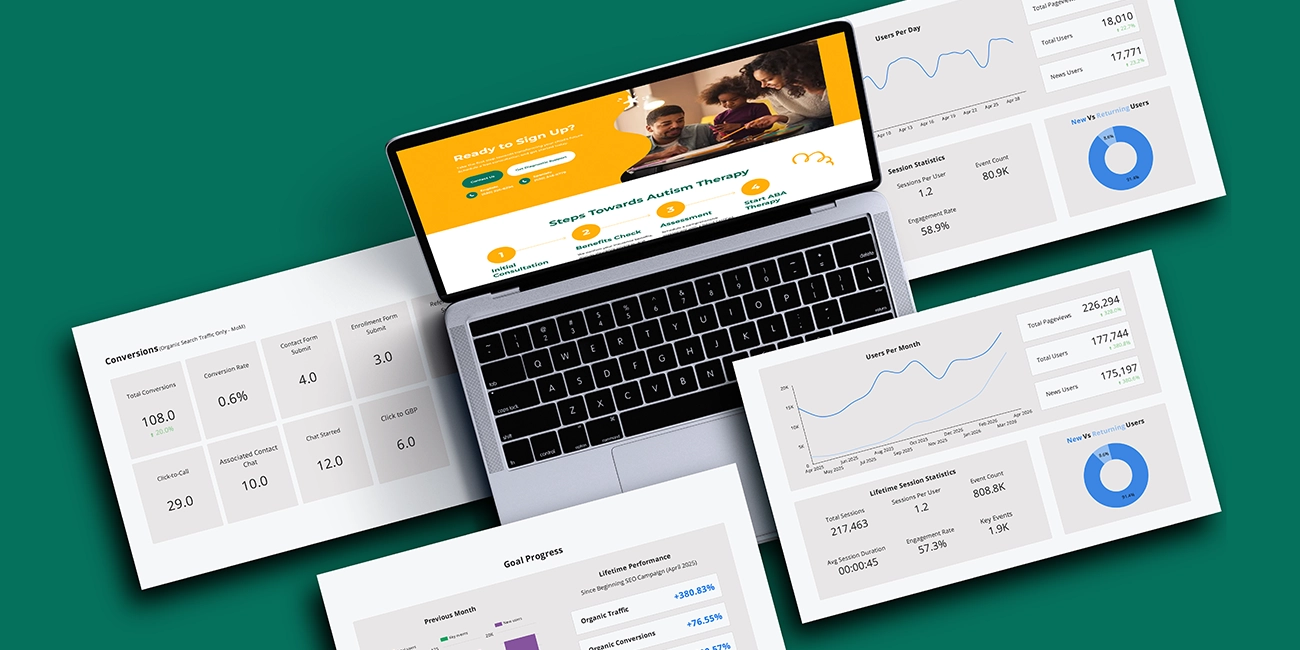



The Benefits of Working With a Specialist Healthcare Marketing Agency:
The Problem
Generalist Agency

Our Approach
A-Train Marketing

Relevant A-Train Proof and Services
Our work in Colorado
Colorado is our home market. We have worked with twenty four organizations in the state, nine of them in behavioral health and healthcare, from offices in Fort Collins, Denver, Colorado Springs, and Pueblo.
Published results here include cost per lead falling 64 percent in the first 90 days for Rooted Behavioral Health, and SolvistaConnect growing users 112 percent and conversions 57 percent in a year. North Range Behavioral Health is the subject of three published case studies covering paid search strategy, a recruitment campaign, and an outdoor campaign.
National benchmarks
Nationally, across behavioral health and healthcare engagements we measure 81 percent organic traffic growth in the first 90 days and an $18 average Google Ads cost per lead. Across ABA and autism engagements, 199 percent organic growth in 90 days and 4,700 organic leads at a 4.5 percent conversion rate.
How long results take
On timing, our client cohort shows median organic sessions reaching roughly 5.9 times the month one baseline by month six, with conversions following two to three months behind.
Colorado Behavioral Health Marketing, Answered
How does Colorado's Regional Accountable Entity structure affect behavioral health marketing?
Health First Colorado administers the behavioral health benefit through Regional Accountable Entities, which receive a fixed monthly payment per member and carry financial risk for behavioral health in their region. Behavioral health is managed regionally rather than carved out to a single statewide vendor. For a provider, that means network decisions, referral relationships and much of the settlement funding run through a regional entity rather than a statewide office, so outreach built for a statewide audience usually reaches the wrong desk.
What advertising rules apply to behavioral health providers in Colorado?
Two federal rules apply regardless of state. The Eliminating Kickbacks in Recovery Act (18 U.S.C. 220) reaches all payers, and its exception fails when compensation varies with referral volume or amounts billed. LegitScript certification is required to run addiction treatment ads on Google, Meta, Microsoft, and Nextdoor. LegitScript applies to addiction treatment advertisers specifically, not to mental health, ABA, or IDD providers, though those platforms' healthcare policies still apply. This is a summary, not legal advice. Confirm current requirements with counsel.
How long does marketing take to work for a Colorado behavioral health organization?
Across A-Train's client cohort, median organic sessions reach roughly three times the month one baseline by month three and 5.9 times by month six, with conversions following two to three months behind traffic. Paid search moves faster, with cost per acquisition typically dropping around 60 percent between month one and month two as targeting tightens. Anyone promising results in 30 days is selling something the data does not support.
What should a Colorado provider expect to pay per lead?
Colorado sits at competition tier 2 of 5 on our report scale, with an index of 1.20, which places it above the national average. Modeled planning ranges are $62 to $84 for substance use disorder, $24 to $33 for mental health, and $33 to $44 for ABA and autism services. These are modeled from national observed results and Colorado's competition tier rather than measured Colorado results, and they are budgeting figures rather than forecasts.
Does A-Train work with Colorado community behavioral health organizations and CCBHCs?
Yes, and Colorado is the state where we have the most work to point to. We have worked with twenty four organizations here across mental health, substance use disorder, ABA and autism services, and IDD services, including community behavioral health organizations, and we maintain offices in Fort Collins, Denver, Colorado Springs, and Pueblo. Published case studies include North Range Behavioral Health, Solvista, and Rooted Behavioral Health.



Schedule a FREE 30-Min Discovery Meeting

Matt Harrington, BCBA, LBA
Growth Strategist