The Real-World Blueprint for Increasing Behavioral Health Admissions
In the world of behavioral health, marketing can feel like a black box. You pour budget into digital ads or social media, but the connection between those “clicks” and actual admissions remains blurry.
At A-Train Marketing, we’ve spent the last 25 years helping organizations across 32 states move past the guesswork. We don’t just act as a vendor. Instead, we’re a specialist agency that immerses itself in the details of care delivery—from ABA therapy and addiction treatment to community mental health.
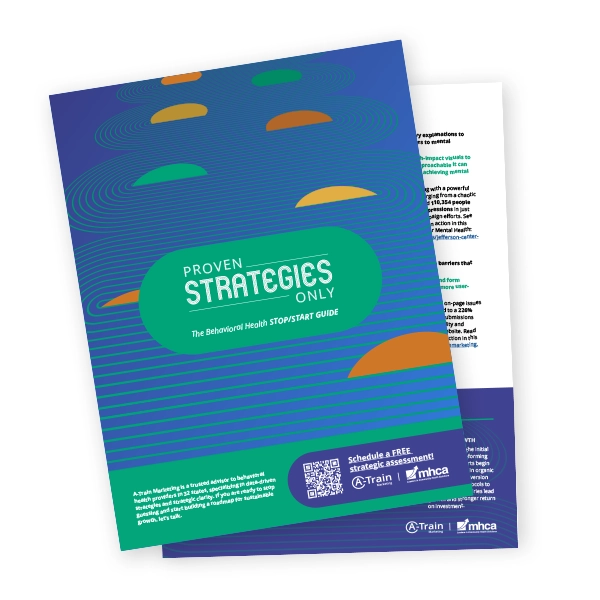
We recently hosted a webinar, “Proven Strategies Only,” to share what’s actually working right now based on live campaign data from over 200 locations. If you missed it, this post breaks down the strategic pillars required to drive long-term growth and stop wasting your marketing budget.
The Benchmarks: Knowing Your Real Costs
You can’t make good strategic decisions if you don’t know your numbers. What we find is that many organizations really don’t know what their actual Cost Per Lead (CPL) or Client Acquisition Cost (CAC) is.
- Average CPL ~ $37
- Average CAC $285–$464
Platforms: Choosing the Right Tool for the Job
Not all platforms fulfill the same purpose. A common mistake is treating every channel as a direct lead generator.
- Digital ads (Google, Meta, etc.). These are used when speed is a priority. They provide immediate volume but are the most costly and highly restricted. If you’re in the SUD space, you have to navigate LegitScript certification, which is a high-paperwork, high-cost barrier to entry.
- SEO. This is the “long game.” The improvements are slower, but the upside is that this strategy builds long-term authority. Crucially, SEO is immune to bidding wars. Unlike ads, where a competitor can just outspend you to take the top spot, organic authority is earned through relevance and technical excellence, meaning it is entirely in your hands.
- Social media. These platforms are about sending “trust signals.” Potential clients or recruits check your Facebook or Instagram to see if you’re a real, engaged part of the community. Posts about “Employee of the Month” or community partnerships show you’re reputable. Purely promotional posts like “Come to our crisis center” generally fail to move the needle.
High Intent vs. Low Intent: The 3.3x Advantage
Most community behavioral health centers focus their spending on top-of-funnel “awareness” campaigns—essentially “spraying and praying” to a broad audience.
- Cold Audience Campaign – 3% Conversion Rate 3%
- Optimized High-Intent Campaign – 10% Conversion Rate 10%
A cold audience campaign (e.g., targeting all parents in a ZIP code) typically achieves a 3% conversion rate. However, optimized high-intent campaigns—where we target people actively seeking specific solutions—achieve conversion rates of 10% or higher. High-intent paid traffic is 3.3 times more effective than cold traffic.
We saw this in action with our client, Rise Up For Autism. They were struggling with rising costs as private-equity-backed firms flooded their market with ad dollars. Instead of fighting a budget war, we shifted to a highly targeted system. We stopped advertising to “all parents” and started targeting parents with specific search histories and demographics who were actively looking for autism services.
The result? Approximately 1.5 times more clients at 40% less cost within just 90 days.
Specificity Always Wins: Why “Addiction Treatment” is a Bad Keyword
If you are trying to rank for generic expressions like “addiction treatment” or “counseling,” you’re typically fighting a losing battle. These terms are too broad—often attracting information seekers and job hunters rather than service seekers—and they are far too competitive to rank for effectively.
Instead, you’ve got to focus on so-called long-tail keywords. They combine level of care, audience specialty, and location. Think: “Residential teen addiction treatment in [City]” or “TMS therapy for seniors near [City].”
General educational blog traffic converts at a very low rate—typically around 2%—while optimized service and location pages convert at 6%. By zeroing in on these specific queries, you’re hitting people who are much closer to making a decision.
Salience Health implemented this by shifting from general instructional content to focusing purely on specialty service and location queries.
Even though they already had high traffic, this pivot led to a remarkable 981% increase in total tracked conversions in just six months.
Fixing the Conversion Point: Your Website is Not a Brochure
You can have the best SEO and a huge advertising budget, but if your website experience is poor, you’re just paying for attention and losing admissions at the final step.
Your website is (or at least it should be) the hub of your entire marketing strategy. Every referral, every social post, and every billboard should lead back to it. Small improvements in your site’s conversion rate (for example, moving from 2% to 4%) can lead to a 200%–400% increase in lead volume without you spending another dime on ads.
We helped our client EDCare address this. They had strong traffic but declining admissions. We realized their site was acting like a brochure rather than a conversion tool. Our team corrected that problem by building out specialized service-location pages with optimized designs—things as simple as changing button colors to “activation” green and limiting forms to only two questions at a time so they weren’t overwhelming.
These tweaks, which some might consider insignificant, resulted in a 62% increase in new leads in only four months.
Your Actionable Roadmap: What to Stop and Start Today
To achieve better results, you need to ruthlessly cut the waste and double down on what works. That means you should…
❌ STOP
- Bidding on general keywords. Don’t pay for “depression info” or other broad terms that don’t lead to admissions.
- Managing 10+ social platforms poorly. Focus on using one or two effectively and stop expecting them to generate leads.
- Sending traffic to generic pages. If a page doesn’t clearly indicate a service, location, or “next step,” it’s a dead end for website visitors.
- Investing without tracking. If you don’t know which channel is driving which lead, you’re wasting money and missing out on opportunities.
✅ START
- Building service + location + audience pages. Make them hyper-focused (e.g., “telehealth addiction treatment for men in Detroit”).
- Implementing urgent CTAs. Replace “Read More” with “Call Now” or “Same-Day Admissions.”
- Tracking everything in granular detail. You need to know conversions by specific clinic location and traffic source.
Accelerating Growth in Just 90 Days
We recommend focusing on creating measurable growth over the course of 90 days.
- Days 1–30: Fix technical barriers, improve website speed, and build your keyword foundation.
- Days 31–60: Deploy your targeted campaigns and replace text-heavy explanations with high-impact visuals.
- Days 61–90+: Scale the winners and refine your reply protocols to deal with the increased inquiry volume.
Eliminating Your Marketing Blind Spot
At a time when every dollar counts, you would assume that every marketing and recruitment dollar is being tracked. Unfortunately, the 2026 data shows a significant ROI blind spot. More than a third (36%) of respondents admitted they are not formally measuring their marketing and communications ROI.
Common refrains from our survey included “We are not formally measuring,” “Not consistently,” and simply “Not well.” When you don’t track your analytics, you are effectively giving away market share to for-profit entities that are using data to target your local patients and talent pool. These competitors are often better at understanding audience needs and engagement preferences. Without foundational web analytics—such as Google Analytics—you might be wasting marketing spend on campaigns that don’t convert. Deploying these tools remains essential to defend your organization’s mission and impact.
Get the Exclusive Guide
We turned our webinar into an easy to utilize PDF checklist. Simply provide your name and email to get access to this helpful resource.