

Serving Providers Statewide
Behavioral Health Marketing in Florida
Trusted by Leading Behavioral Health & Medical Brands


Florida's Behavioral Health Landscape
Florida writes rules for behavioral health marketing directly into statute, and that shapes every provider's outreach.
Most Florida Medicaid recipients are enrolled in Statewide Medicaid Managed Care, which covers Managed Medical Assistance, Long-Term Care, and dental programs. For a provider, plan contracts and authorization rules sit between the organization and many of the people it serves, so confirm them plan by plan.
Florida statute 397.55 bars deceptive marketing by substance use treatment providers, recovery residence operators, and the third parties who market for them, including false website information, hidden redirects, and undisclosed paid lead generation. Patient brokering is a criminal offense under section 817.505. Every claim, call line, and referral arrangement an organization publishes is a compliance document as well as a marketing one.
Opioid settlement money flows through the Department of Financial Services' clearing trust fund, with the Statewide Council on Opioid Abatement advising on spending and a regional fund receiving 30 to 40 percent of each year's share. SAMHSA's 2023 survey reported 12 treatment facilities classified as CCBHCs in Florida, and suicide ranked as the 8th leading cause of death in the state in 2024.
The result is a market where trust is regulated as well as earned, for mental health, substance use, ABA and autism, and IDD organizations alike.
Sources: Florida Agency for Health Care Administration; Florida Statutes 397.55, 817.0345, and 817.505; NASHP state opioid settlement tracker, 2025; SAMHSA N-SUMHSS 2023; CDC NCHS state profile, 2024.
Florida Behavioral Health Marketing Snapshot
Market structure
- Medicaid program: Florida Medicaid (Public, Florida AHCA)
- Medicaid delivery model: Statewide Medicaid Managed Care, covering Managed Medical Assistance, Long-Term Care, and dental (Public, Florida AHCA)
- Marketing statutes: Deceptive marketing ban (397.55), false treatment marketing felony (817.0345), patient brokering ban (817.505) (Public, Florida Statutes)
- CCBHC-classified facilities: 12 in SAMHSA's 2023 survey, self-reported (Public, SAMHSA N-SUMHSS 2023)
- Suicide rank: 8th leading cause of death, 2024 (Public, CDC NCHS)
- Opioid settlement split: 45 to 55% state, 30 to 40% regional, 15% city and county (Public, NASHP 2025)
Market economics
- Substance use search demand, Miami: 90 searches a month, difficulty 50 (Public, Semrush, September 2026)
- ABA search demand, Miami: 390 searches a month, difficulty 16 (Public, Semrush, September 2026)
How Florida compares
- Report tier: 1 of 5 on our editorial scale (Modeled, method)
- Cost per lead, substance use disorder: $78 to $105 (Modeled, method)
- Cost per lead, mental health: $31 to $41 (Modeled, method)
- Cost per lead, ABA and autism services: $41 to $55 (Modeled, method)
- Metro median keyword difficulty, all 51 markets: 49 substance use, 18 ABA (Public, A-Train benchmark report from Semrush, 2026)
Modeled rows use A-Train's national observed cost per lead adjusted by an editorial state tier. They are planning estimates, not measured Florida results; see the method and its limits.
Tim Zercher's Take on Florida

Florida is the state where I tell clients to read the statute before they read the keyword report. Section 397.55 reaches the marketer as well as the provider, so the questions I would ask any partner here are simple: where do the leads come from, who pays for them, and what is the person told on the first call.
Most of what I know about Florida comes from our work with MedMark Treatment Centers, a former client with programs in the state, and from Florida operators on our podcast. The legislature wrote these protections because families were being misled, so being easy to verify is a real advantage: licensure visible, calls answered by your own staff, plain language about what you treat and what you do not.
On search, Miami is two markets. The ABA term sits at difficulty 16 and the substance use term at 50, so one plan will not fit both.
Basis for this assessment: A-Train's work with MedMark Treatment Centers, a former client operating in Florida, plus Florida provider conversations and Tim Talks: Behavioral Health interviews. Not a measured Florida result.
Voices from Florida Behavioral Health
Tim Talks: Behavioral Health
A fast-paced podcast featuring candid, 10-minute conversations with leaders across the behavioral health field.
One Tim Talks conversation speaks directly to a Florida audience: families looking for coordinated autism services, and the providers trying to grow without breaking the trust that brought those families in.
Carly and Jon Weinberg, Co-Founders, Beyond ABA Therapy and Project Infinity School
Carly Weinberg co-founded Beyond ABA Therapy and Project Infinity School in Florida and leads the school's educational and clinical model, which integrates academics with speech, occupational therapy and ABA. Jon Weinberg is Co-Founder and Managing Director, bringing a business strategy and operations perspective to integrated autism and educational services.
On the episode they describe the Boca Raton school model, a pace of growth deliberately tied to hiring and culture, and why word of mouth and follow-through build more family trust than any campaign. They also talk through hiring and waitlists, where growth and honest communication with families meet.
In this episode: 00:13 the Boca Raton model, 01:56 intentional growth, 05:41 word of mouth, 07:10 family trust, 08:22 hiring and waitlists.
For a Florida provider in any service line, the lesson travels. In a state where marketing claims are regulated, the follow-through families experience after the first call is the marketing.
Listen to Carly and Jon Weinberg on Tim Talks: Behavioral Health
The Weinbergs appear as podcast guests and are not A-Train clients; their experience describes one organization, not Florida as a whole.
What This Means for Behavioral Health Providers in Florida
Treat every lead source as a compliance question
Statute 397.55 applies to substance use providers, recovery residence operators, and the marketers who work for them, and it requires disclosure when a call center or website generates paid referrals. Before adding any lead vendor, directory, or call line, document how it generates contacts and what the person is told. The same discipline protects mental health, ABA, and IDD organizations.
From: Florida Statutes 397.55 and 817.505.
Miami runs two different organic markets
In Miami, the substance use term sits at difficulty 50 with 90 monthly searches, while the ABA term sits at 16 with 390. The ABA term is easier than the national metro median of 18 and carries more than four times the volume. Whatever service line you run, plan organic work against the difficulty your own terms show, not a statewide average.
From: Semrush metro volume and difficulty; benchmark report metro medians.
Budget against a modeled range, then measure
Modeled cost per lead for Florida runs $78 to $105 for substance use, $31 to $41 for mental health, and $41 to $55 for ABA and autism services. Those are planning ranges anchored to national results, not measured Florida costs. Use them to size a first test budget, then replace them with your own account data, since paid costs typically fall sharply after month one.
From: Report tier, modeled cost per lead, paid efficiency benchmark.
Our Behavioral Healthcare Marketing Services








The Benefits of Working With a Specialist Healthcare Marketing Agency:
The Problem
Generalist Agency

Our Approach
A-Train Marketing

Relevant A-Train Proof and Services
Our Florida experience
MedMark Treatment Centers, a former client, operates opioid treatment programs in Florida. Our published MedMark case study shows organic conversions up 92 percent while rankings held through a Google algorithm update, which matters in a state where every marketing claim is scrutinized.
Proof for autism services
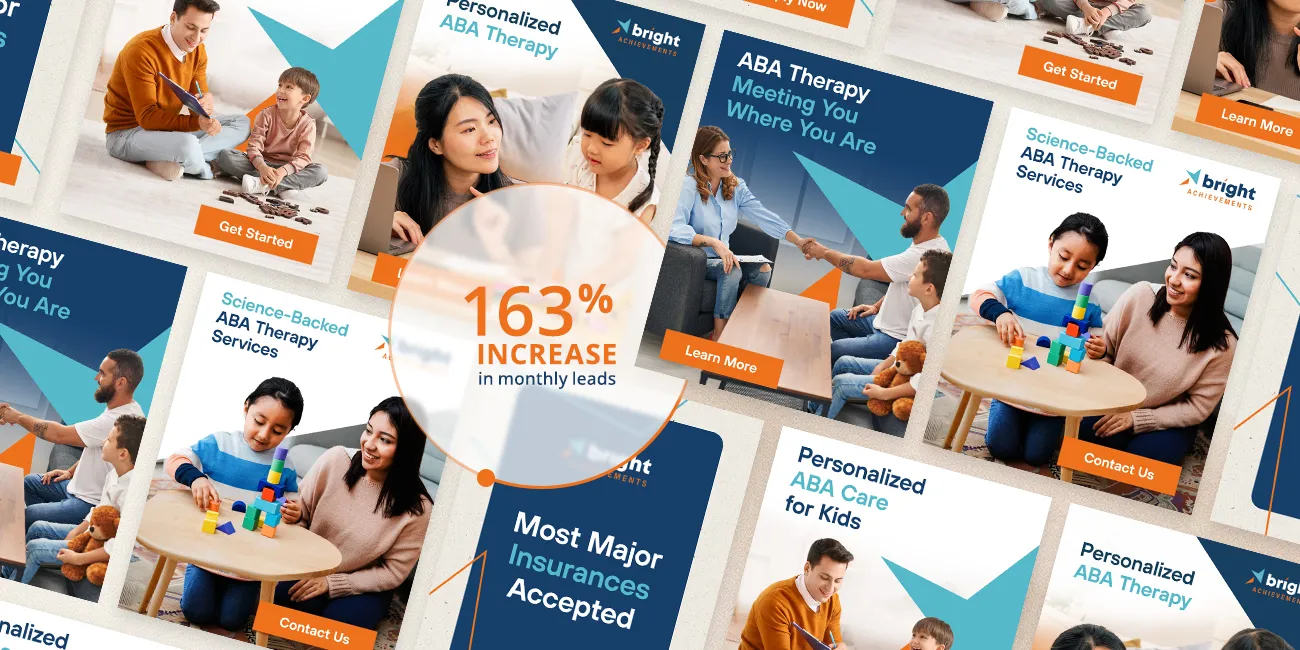
For ABA and autism providers, Bright Achievements cut cost per lead 62 percent while growing leads 163 percent on the same budget.
Timing and services
Our ABA clients reached about 2.2 times baseline sessions by month three in a small sample. Matched services for Florida: SEO and AIO and recovery and addiction treatment marketing, with the same verification-first approach for mental health and IDD providers.
Florida Behavioral Health Marketing, Answered
How does Statewide Medicaid Managed Care affect behavioral health marketing in Florida?
Most Florida Medicaid recipients are enrolled in Statewide Medicaid Managed Care, which includes Managed Medical Assistance, Long-Term Care, and dental programs. For a provider, plan contracts and authorization rules shape who can be served and how referrals arrive, so outreach to plans and care coordinators matters alongside consumer marketing. Confirm the current plan roster and each plan's behavioral health rules directly, since they change and vary by plan.
Which marketing laws apply to Florida behavioral health providers?
Florida statute 397.55 prohibits deceptive marketing by substance use treatment providers, recovery residence operators, and third parties that market for them, including false website information and undisclosed paid lead generation through call centers or websites. Section 817.0345 makes certain false treatment marketing statements a felony, and section 817.505 prohibits patient brokering. At the federal level, the Eliminating Kickbacks in Recovery Act (18 U.S.C. 220) applies to all payers and does not protect compensation that varies with referral volume or amounts billed, and Google, Meta, Microsoft, and Nextdoor require LegitScript certification for addiction treatment ads. This is a summary, not legal advice. Confirm current requirements with counsel.
How quickly does marketing show results for a Florida provider?
In A-Train's client cohort, organic sessions start moving around month three and reach roughly 5.9 times the month one baseline by month six, with conversions trailing traffic by two to three months. ABA clients have moved faster early, reaching about 2.2 times baseline sessions by month three in a small sample, which matters in a market like Miami where the ABA term sits at difficulty 16. Plan for months, not weeks.
What does a lead cost for a Florida behavioral health provider?
We do not have measured Florida costs to publish, so we model them. Florida sits in tier 1 on our report's editorial scale, which gives planning ranges of $78 to $105 for substance use disorder, $31 to $41 for mental health, and $41 to $55 for ABA and autism services. Treat these as order-of-magnitude budget figures anchored to our national observed results, and replace them with your own account data quickly.
Has A-Train worked with Florida providers?
Yes. MedMark Treatment Centers, a former client, operates opioid treatment programs in Florida, and our published MedMark work shows organic conversions up 92 percent through a Google algorithm update. We are based in Colorado and work with Florida organizations across mental health, substance use disorder, ABA and autism services, and IDD services.



Schedule a FREE 30-Min Discovery Meeting

Matt Harrington, BCBA, LBA
Growth Strategist