Watch This Episode
Listen
Now I See a Person: Rethinking Mental Health Care Beyond the Diagnosis
What changes when mental health care sees the person before the diagnosis?
On this episode of Tim Talks: Behavioral Health, Tim Zercher sits down with Dr. Susan Swim, Executive Director of the Now I See a Person Institute, along with Christina and Ashley, for a conversation about human connection, dignity, trauma, and alternative approaches to mental health care, along with lessons that can shape more compassionate mental health care marketing.
Dr. Swim reflects on more than four decades in the field and why her work has increasingly focused on moving beyond labels and pathology toward Collaborative-Dialogical Practices. The conversation explores what can happen when practitioners listen to each person’s individual story, allow clients to help lead the conversation, and approach healing through relationship rather than a predetermined path.
Christina shares how her own difficult experience seeking mental health care led her to question who traditional systems and processes are really designed to serve. Ashley discusses the role empathy, human connection, nature, and physical environments can play in a person’s experience of care.
Together, they explore a different question for behavioral health leaders, practitioners, and teams working in mental health care marketing: What becomes possible when we stop defining people by a diagnosis and start meeting them as individuals?
Seeing the Person Before the Diagnosis
Dr. Susan Swim, Executive Director of the Now I See a Person Institute, has spent more than four decades in mental health care. Her work centers on a simple but powerful shift: approaching each person through the lens of their own story, rather than through the lens of what others have written about them. In Collaborative-Dialogical Practices, the client is treated as the expert on their own life. The practitioner’s role is to listen, stay curious, and accompany the person through the conversation rather than direct it.
For clinicians, this can mean setting aside assumptions formed from intake paperwork or prior records and letting a person’s narrative unfold, knowing it may change as trust builds. As Dr. Swim puts it, people are brilliant, and care works best when it is tailored to the individual in front of us.
When the System Isn’t Built Around the Person It Serves
Christina’s path into this work began with her own experience seeking support after a series of losses during the COVID-19 pandemic, including the death of a close friend. When she reached out for help, she was waitlisted for nearly two years, in part because providers struggled to settle on a diagnosis. She described feeling managed, dismissed, and judged at a time when she needed support right away.
That experience led her to ask a question every behavioral health leader can benefit from asking: at each step of the process, who is this really for? Intake procedures, documentation requirements, and diagnostic timelines exist for real reasons, but when they delay care or leave people feeling unheard, they can work against the very people they’re meant to serve. Christina ultimately found Collaborative-Dialogical Practices and narrative therapy, which now shape how she approaches her own practice.
The Healing Role of Environment, Nature, and Connection
Ashley, a wellness coach with the Now I See a Person Institute, first encountered the institute as a teenager, when Dr. Swim’s work took place on a ranch. Connecting with horses and receiving care in that setting reshaped her understanding of what mental health support could look like. Today, her focus is on how deep empathy, human connection, and thoughtfully designed spaces can support a person’s wellbeing.
The physical environment is often an afterthought in behavioral health settings, yet the spaces where people receive care can influence whether they feel safe, respected, and at ease. Access to nature, calm and welcoming rooms, and genuine relationships with staff all contribute to a person’s experience of care.
About Our Guest: Susan Swim
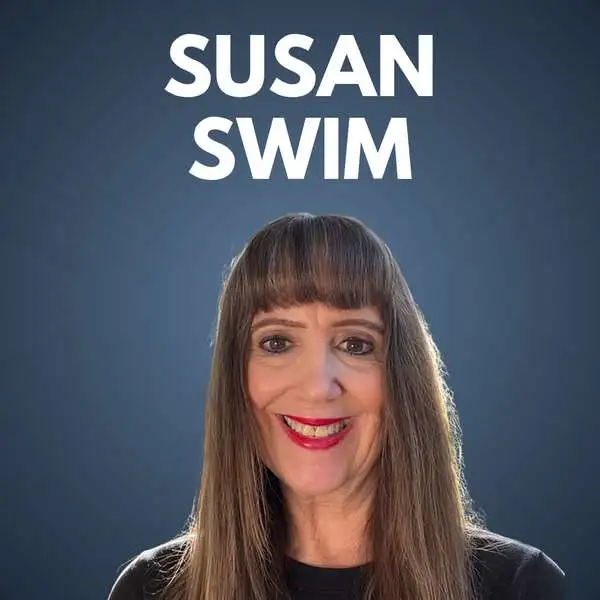
Dr. Susan Swim is the Executive Director of the Now I See a Person Institute, a nonprofit mental health, research, education, and training organization focused on healing underserved populations from trauma. A researcher, author, educator, supervisor, and clinician, Dr. Swim has spent more than four decades working with Collaborative-Dialogical Practices and exploring relational approaches to mental health care centered on dignity, dialogue, human connection, and possibility.
Visit the Now I See a Person Institude website to learn more about them and their mission.
Episode FAQ
How can mental health organizations care use person-first language in their marketing?
As Dr. Susan Swim shared on Tim Talks: Behavioral Health, people want to be seen as individuals, not defined by a diagnosis. Marketing can reflect that same value. Person-first language, such as “a person living with depression” rather than “a depressed person,” helps reduce stigma and signals respect before someone ever picks up the phone. A-Train Marketing helps behavioral health and addiction treatment providers review website copy, ads, and social content so their messaging feels compassionate, accurate, and aligned with how they actually deliver care.
Why does the patient experience matter for mental health care marketing?
In this episode, Christina described being waitlisted for nearly two years and feeling “managed” rather than helped. Experiences like hers show that marketing and patient experience are closely connected. If a website is confusing, an intake form is overwhelming, or no one follows up, people may give up before they receive care. A-Train Marketing looks at the full path from first search to first contact, including site navigation, mobile usability, calls to action, and contact forms, to help providers make reaching out feel simpler and more welcoming.
How can treatment centers showcase their environment and approach online?
Ashley spoke about how nature, beautiful spaces, and human connection shaped her experience of care. For many people researching treatment, the setting and the philosophy of care matter as much as the services offered. Authentic photography, virtual tours, staff introductions, and clear descriptions of a program’s approach help prospective clients and families picture themselves there. A-Train Marketing helps organizations tell that story through website design, video, and content that reflects the real experience of their programs.
Can behavioral health providers share client stories without compromising privacy?
Christina and Ashley chose to share their own journeys publicly, and personal stories can be powerful for reducing stigma and building trust. But in behavioral health marketing, privacy must always come first. Any story should be shared only with informed, written consent, and organizations should avoid publishing protected health information or implying specific treatment outcomes. A-Train Marketing follows HIPAA-conscious practices and helps providers develop ethical approaches to storytelling, including podcasts, staff-led content, and educational pieces that build connection without putting anyone’s privacy at risk.
Episode Transcript
View the full transcript
Timothy Zercher 0:00
Dr. Susan, thank you so much for joining us. We really appreciate you taking time to join us and share some of your experience.
SPEAKER_02 0:06
Well, I just want to let you know that we’re all very excited to be here. I did invite a couple of our faculty members to be with us today. And um let them introduce themselves at the end of this in order to kind of streamline this a little bit.
Timothy Zercher 0:19
First question is you spent decades in this space of forming dialogue and forming different approaches to mental health care. What first drew you into the space and what’s kind of kept you committed over so many years?
SPEAKER_02 0:30
Thinking about the question of what drew me into this is that this was kind of the space that I was educated in in the late 70s and early 80s. And so it was a time that a lot of us were exploring alternative ways of describing why people were having problems or why they were having challenges. And so I think that there were a lot of people, if you study a lot of people that are my age, they were there before the introduction of SSRIs. We were there before the ESM came out with the biopsychosocial model. And so before those things, most people healed. Most people found wellness. I think I was researching this yesterday that we have from the time I was first practicing or studying in graduate school, there’s 500% more providers and treatment than there was at that point.
Timothy Zercher 1:26
Yeah, yeah. And I think that’s obviously then there’s the reason of why you’ve stayed committed, right? That the problem has not gone away. If anything, it’s gotten worse. And and therefore your investment has continued. I sense a recurring theme in your work, and that’s that moving beyond labels and diagnosis towards real human connection and dignity. What experiences led you to challenge the more traditional health mental health frameworks, if you wouldn’t mind?
SPEAKER_02 1:50
You know, I always when I hear the word kind of challenges, I think. Well, I didn’t really mean to challenge because I’m not really a rabble route, like rules and like to kind of follow those rules. But as time went on, we could see that things were happening in a way that really didn’t make sense to us. So, for example, I kind of the analogy I was thinking about was a broken leg. So let’s just say that we have a broken leg on Friday and we go and see somebody on Monday, we see a different practitioner that next Wednesday, and that next Wednesday, that practitioner says, This is due to a biological problem. This is due to a deficiency. And so before this, most symptoms were due to trauma. And so you would see so much the trauma being overlooked, and that people became worse because they were being medicated. I think you’ve had other people on your show before talking about the medicalization of mental health. And so it was really something that you just saw this kind of pyramid falling apart and more and more people needing services, more and more people thinking they couldn’t get well or that there was fear.
Timothy Zercher 3:04
Absolutely. Absolutely. So I want to ask more about that, right? You’ve worked with many individuals who, I guess, another way to say that have kind of lost hope after years of traditional system care that they’re going to be better, that they’re going to feel better. What have some of those experiences taught you about what truly drives healing and recovery for individuals suffering from trauma or complex sets of diagnoses?
SPEAKER_02 3:27
So we talk now about humanizing ourselves for the epic. And we do a lot of conferences on that, a lot of writing. And so, how we as practitioners can we be able to so that we go in when we talk to somebody, the lenses that we have are the lenses what every person is saying, not the lenses of what other people have said. And when you start talking to people, each person has their own narrative, and that narrative might change throughout the time that you’re talking with them. And so people are brilliant. You know, we don’t see people as being broken or to the lenses of pathology. And so we really allow the client to be the expert and to lead us in the conversation, and we accompany them on these conversations. So all everything itself tailored to that client.
Timothy Zercher 4:16
I like that. I like that. So there’s not some kind of single path to healing, right? It depends on the client. It depends on what how they envision their healing journey. I love that. I love that. So, Christina, I want to turn to you now and learn a little bit about your approach because I know it’s it’s similar. And I think you kind of came to the same approach in a different way.
SPEAKER_01 4:35
Yeah. So I came to this ideology after COVID. So there were a series of pretty horrific events that happened to me during the pandemic, which began with the death of a close friend and was followed by more deaths of young people. And then just a really difficult time during the pandemic, lots of things I lived through during that time. And I reached out for mental health care and pretty much everything that could have stereotypically, institutionally gone wrong, I guess, as we might think that things could go wrong, did go wrong. And I very much felt managed. I came to realize that my experiences there were not unique. I felt dismissed, judged, like my problems were either hypothetical, self-generated, or eventually as if I was fundamentally broken. I was waitlisted for nearly two years. And a big part of that time was they were struggling to find a diagnosis for me. And I thought about that and I thought, this is ridiculous. Like I needed help yesterday. I needed help over a year ago. Why is this taking so long? And I thought, why is this important to helping people? And that made me think more about the models with which we deliver care under. And I started asking myself in each step of the process, who is this for? It’s not for the client, it’s not for the patient, it’s not for me. And that made me think about how I wanted to shape my practice. I got in touch with, well, I was looking for other models of care. I found out about collaborative dialogic practices and also about narrative therapy. And that’s how I got in touch with Dr. Swim and her work.
Timothy Zercher 6:16
That’s awesome. That’s awesome. Thank you. Thank you. I mean, I’m sorry to hear that that was your experience, but I think it’s a unfortunately common experience, right? That the weightless and failed diagnosis and feeling managed, I think happens a lot in the institution. And I love that well, all three of you are working to combat that kind of standard process. So, Ashley, if you wouldn’t mind, I want to turn to you and I want to hear a little bit about your approach and the process that you’re studying as well.
SPEAKER_03 6:42
Hi, yeah, thank you. Right. So I’ve been in a wellness coach here now, AC person, for like two years and some change. And I’ve actually known the institution for a very long time, like since middle school. But I’m personally really interested in seeing how people transform and you have this like really deep level of empathy with them and human connection, and specifically also when you give them beautiful spaces and beautiful experiences, and seeing how that helps their life unfold in a manner that is harmonious and beautiful. And like what role does nature play into this? And what role does like we write a lot about how beautiful spaces create this sense of healing and magic. And like I said, that I’ve known the institution since I was like what like 14. So I s I actually got to know him and Dr. Simb is still on a ranch. And you know, connecting with the horses and connecting like receiving care and understanding care in that ranch setting just flipped the whole mental health system on its head. And I think that was something profound.
Timothy Zercher 8:04
Absolutely. Yeah, I think it’s I think it’s really interesting. I don’t think people often understand, especially within the industry, the impact that our environment has on our own mental health. I I think it’s very cool that is what you’re focusing on. That’s where you’re pushing your service to your clients. Well, Dr. Swim, would you like to say any anything to add to add as we wrap up?
SPEAKER_02 8:25
So one of the things is that the reasons why I invited both Ashley and Christina today is that they had their own diagnosis at one point in time, whether they were young or maybe a little bit older. And these were things that they were able to transform from. And so what we have found is that when people quit being defined by a diagnosis and they’re defined by what stuff they want to be defined by. And so I think both Ash and Christina are wonderful examples of how people can transform and they leave behind those diagnoses. They don’t have to be worried that diagnoses are going to come back because they don’t see them as something legitimate in their life. And I think that a lot of people come to that understanding. I was reading something yesterday on the Clancy case. And I think that you have that’s why there’s a huge flash about medications, is because it’s almost bringing together the voices of these women. We’re hoping that our voices can raise awareness of some of that. It was meant to be accompanied with people, wasn’t meant that we’ve wanted to diagnose you and then treat you as a diagnosis nor everyone else is like off the line.
Timothy Zercher 9:38
Absolutely. Absolutely. Well, thank you so much. I really appreciate all three of you taking time to join us and sharing your perspective. I think it’s an important perspective that more people need to understand and need to adopt. So thank you so much.