Watch This Episode
Listen
What Behavioral Support Gets Wrong About Real Life
In this episode of Tim Talks: Behavioral Health, Tim Zercher sits down with Marla Schneider, Founder and CEO of Iridescent Behavior Support Services, to discuss what it really takes to support individuals with developmental disabilities and the people who care for them every day.
Marla shares how a major personal health experience changed the way she sees disability, dignity, and the importance of making people feel seen. She also explains why behavioral support can’t stop with the individual, why caregivers and frontline staff need strategies that work in real-life situations, and how providers can rethink what meaningful progress actually looks like.
The conversation also explores the challenges of serving adults with developmental disabilities, building the right clinical team, staying true to organizational values while growing, and why short-form video may become an increasingly important tool for behavioral health organizations.
It’s a practical conversation about quality of life, sustainable support, and building services around the realities families, caregivers, and clinicians face every day.
Finding Purpose Through Lived Experience
Marla Schneider’s path into behavioral health began with a simple pull toward helping people with developmental disabilities across every age and ability level. But it was a period of serious personal illness — one that left her using a wheelchair — that truly shaped her approach. During that time, she experienced firsthand what it felt like to be spoken past or overlooked, even without any cognitive or intellectual disability of her own. That experience became the foundation for Iridescent: a commitment to seeing every individual fully, and making sure they feel valued in every interaction.
Closing the Gap Between Clinical Plans and Real Life
One of the biggest opportunities Marla sees in the field is better preparing the caregivers, families, and support staff who are present day in and day out — not just the clinicians who visit periodically. Real environments don’t offer the same control a clinical session does, so her training emphasizes consistency under real-world conditions: what happens when a caregiver is tired, when routines break down, or when progress looks different than expected. She also challenges the field to rethink what “progress” really means — sometimes the goal isn’t to eliminate a behavior, but to improve quality of life for everyone involved.
Growing a Team — and a Business — Around Core Values
Recruiting clinicians willing to work with adults across the full spectrum of developmental disabilities (not just autism) remains one of Marla’s biggest staffing challenges, largely due to unfamiliarity and understandable hesitation. Rather than adjusting her approach to attract a wider audience, she’s found that staying consistent to her organization’s values is what draws the right team members and clients — the ones who share that same long-term vision for care. Looking ahead, she’s also keeping an eye on short-form video as a way to reach people who are busy, informal, and increasingly drawn to quick, authentic content.
About Our Guest: Marla Schneider
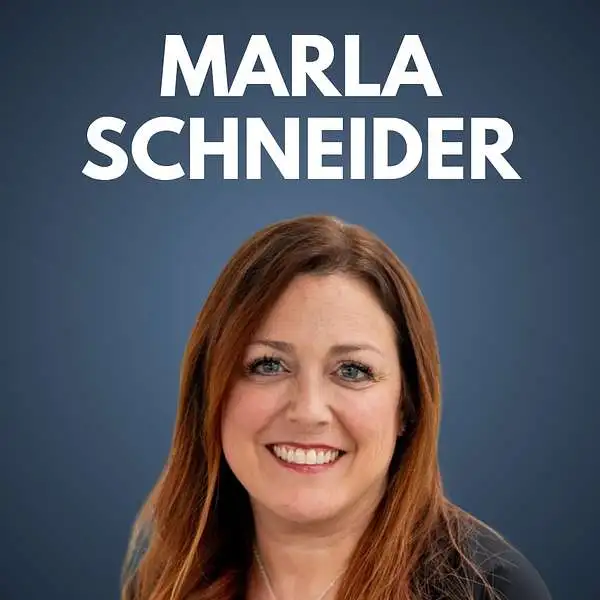
Marla Schneider is the Founder and CEO of Iridescent Behavior Support Services. With more than 20 years of experience supporting individuals with developmental disabilities, Marla is passionate about improving quality of life through practical behavioral supports, caregiver education, and professional training. Her work emphasizes collaboration with families, clinicians, and support teams to create strategies that can be successfully applied in real-world environments.
Visit the Iridescent Behavior Support Services website to learn more about Marla Schneider.
Episode FAQ
Why is caregiver training so important in developmental disability support?
Caregiver training matters because family members and support staff are present far more consistently than any visiting clinician. As Marla Schneider explains, effective training goes beyond initial strategies — it prepares caregivers to maintain consistency even in unpredictable, real-world conditions, such as when they’re tired or routines are disrupted. This ongoing consistency is often what makes a lasting difference in someone’s day-to-day quality of life.
What does progress look like in behavioral support for developmental disabilities?
Progress isn’t always about eliminating a specific behavior. According to Marla Schneider, the goal is often to improve overall quality of life for the individual and everyone in their environment. This person-centered approach focuses on what’s realistic and meaningful for each person, rather than applying a one-size-fits-all standard of “fixing” behavior.
Why is behavioral support for adults with developmental disabilities different from support for children?
Working with adults involves a different dynamic than pediatric care. Many adults have already spent years in various therapies, so behavioral support often focuses on fine-tuning and reinforcing existing skills for the long term, rather than early-stage intervention. Marla Schneider notes that this specialization is less common in the field, in part because clinicians often have limited experience working with adults across the full range of developmental disabilities.
How can behavioral health and developmental disability organizations market their family support services effectively?
Organizations serving families of individuals with developmental disabilities often struggle to communicate their value in a way that resonates — families are searching for trust, expertise, and real understanding, not just service lists. A-Train Marketing’s Family Support Marketing Services help organizations translate lived expertise (like the caregiver training and person-centered approach discussed by providers such as Iridescent) into content that builds credibility, improves search visibility, and connects with families at the moment they’re looking for support.
Episode Transcript
View the full transcript
Timothy Zercher 0:00
Well, Marla, thank you so much for joining us. We really appreciate you taking time.
Marla Schneider 0:04
Thank you for having me. It’s so nice to meet you.
Timothy Zercher 0:06
Absolutely. I’m excited to talk today. You’ve spent more than 20 years supporting individuals with developmental disabilities and of course supporting their families as well. What first inspired you to pursue a career in behavioral support services?
Marla Schneider 0:20
To be honest, I kind of fell into it. I knew I wanted to work with developmental disabilities. I love the population. And I came, I came about this opportunity to work with all developmental disabilities with ages from three to elderly. And I thought, what an amazing opportunity. And so when I got into the behavior piece and started to learn, I just found it so amazing to be able to help people of such a large range and to be able to basically have a different day every day.
Timothy Zercher 0:52
Yeah, it’s it’s never the same. It’s never the same day, Toy. Is it you launched Iridescent after a pretty significant life event? How did that experience shape your vision for the organization?
Marla Schneider 1:02
It’s interesting. You go into this field and you want to help people. And, you know, I was, I felt like I was born to be a helper. And so I was thought, well, I must be good at it because I’ve been like helping people. This is where I’m drawn to. And then, you know, I get into this short period of time in my life where I was very sick. And, you know, I had a wheelchair, definitely different things like that. And so I was really struck by how people looked at me or didn’t look at me. And they would talk to the person that was with me, but it was as if I didn’t exist. And I hadn’t seen that side before. I had heard about it, but I didn’t truly understand because I was like, well, they have multiple disabilities. Maybe they’re seeing different things and maybe people are just uncomfortable. But here I’m somebody that I don’t have a disability mentally or cognitively. And so here people were still looking past me like I was nothing. And I had to ask for a lot of help, which was not my go-to. So I feel like it changed the trajectory of how I treat the individuals and their families. And I feel like I look at them and I see all these great things about them. And I make sure I incorporate it into every conversation and interaction so that they know how valued they are as people.
Timothy Zercher 2:23
Though that’s a hard story, and I’m sorry you had to go through it, that’s an incredible story at the same time. I think I love that you have that perspective. I don’t think I hear that very often. People don’t understand the not being seen, I think, aspect of disabilities.
Marla Schneider 2:40
Absolutely.
Timothy Zercher 2:41
Yeah. So a major focus of your work is training caregivers, families, and professionals. Where do you think the industry still has the biggest opportunities to improve education and support for those frontline staff members?
Marla Schneider 2:55
I think a lot of times our field focuses on going in there and focusing on the individual and building their skill. And it’s almost like we go in and then go out. And we’re not the people that are there day in and day out. And I think that where I would like to see more learning and growth is for clinicians to recognize the people that are there day in and day out have to be able to implement it. And they have to know how to implement it when real life happens, right? So you go into environments, no control, but yet we come in and we control the environment and everything looks a certain way. And so we’re asking people day in and day out to implement things that sometimes aren’t possible. So I focus a lot of my training on what happens when you’re tired? How does this look different? How do you use the principles and the rules and all of those things and still maintain consistency so that you can actually get a longer-term progress? And really, the biggest question is what is progress? What is your actual goal? We go in there and we want to fix, but sometimes it’s really just bringing the quality of life for everybody in the environment, including the individual. And I think sometimes everybody else and everything else in the environment is overlooked, including the clinician’s role in a situation. So sometimes people have trouble actually even documenting how they impacted the behavior within the room.
Timothy Zercher 4:25
Absolutely. Absolutely. Well, and I love I love that aspect that you you called out. The goal is not always to fix the problem, right? Sometimes the goal is very small or very focused. And I think often clinicians miss that as well because they have kind of the standard set of we want to reduce these behaviors and increase these behaviors, or something along those lines is like, yeah, sometimes, and sometimes not, right? Sometimes that’s not at all the problem. So I know that your space can be very hard to grow in, especially when it comes to staffing. What have you found is the hardest part about growing your team?
Marla Schneider 4:59
Honestly, it’s funny. I feel like the hardest part is the fact that we work with adults. I think that sometimes scares people off because they don’t have as much of experience with that, in addition to the fact that we aren’t strictly working with autism. We’re working with all developmental disabilities. To me, I love it. It gets you to know so many different people and so many facets to how behavior works, and it just makes the world look different. But a lot of times when I’m going to interview clinicians, that’s the one thing that they’re very intimidated by is adults. Or am I going to go in there and get hurt? Which is an understandable fear, but it’s actually pretty amazing to, you know, you’re working with people that often have had years of therapy, like behavior therapy, all sorts of speech language, all that. And you’re almost coming together and fine-tuning the last touches, kind of making it better, making it work longer term. And so it’s actually a pretty unique experience. And I find it to be very valuable. But I do find when I’m trying to hire, people don’t even want to touch it.
Timothy Zercher 6:12
Yeah, I’m sure. I’m sure. It is a very different space working with adults than it is with working with children. It makes total sense why that would be intimidating sometimes. So, what works best for you right now, especially outside of word of mouth when it comes to client acquisition and growing your client base?
Marla Schneider 6:28
I think really staying true to what I believe in and making sure our company is moving in that direction. So all my team members are really staying true to what are what we value. And so I do believe that there is a time and place for every single clinician, right? So I really truly want the best outcome for each individual. And so to me, if I’m staying true to what our value is and how we do things and we get the right people that match up with that, then that’s a win-win. And so I don’t change to mold to who my audience is to get more clients or whatever. I actually keep consistent. And so the ones that stay with us are actually ones that want to grow in the same way that we can offer.
Timothy Zercher 7:18
I love that. I love that. What is one marketing tactic or strategy that you’re either considering for your team or that you’re just watching really carefully in the marketplace right now?
Marla Schneider 7:28
It’s actually funny. I got these ideas from my kids. They’re a lot smoother with the technology and probably a bit cooler and funnier than I am. But they really talked about how important that these short clips are. Much like you’re saying is people are busy and people are on the go and having a short little video that kind of says a point, gets it across very quick. But even just a few seconds, like a 30-second to two-minute video that shows a sense of humor and gets people in and really gets them to think about the idea. Still try to figure out. I don’t necessarily have the tech skills. Like I said, I’m not as cool as my kids, but I do believe that it is what the next stages are. People are busy, they’re looking at quick clips that that’s just really how the day and time is, and it’s continuing to move more and more in that direction.
Timothy Zercher 8:23
Definitely. Definitely. Yeah, video content is the future of communication in a lot of ways. In a lot of ways. Perfect. Well, thank you so much, Marla. I appreciate you taking time. I appreciate the work that you’re doing for the individuals that you serve that don’t have a lot of options sometimes, and for your team.
Marla Schneider 8:36
Well, thank you so much for talking to me today. I appreciate it.
Timothy Zercher 8:39
Absolutely.