
Recruitment and Branding Trends Report
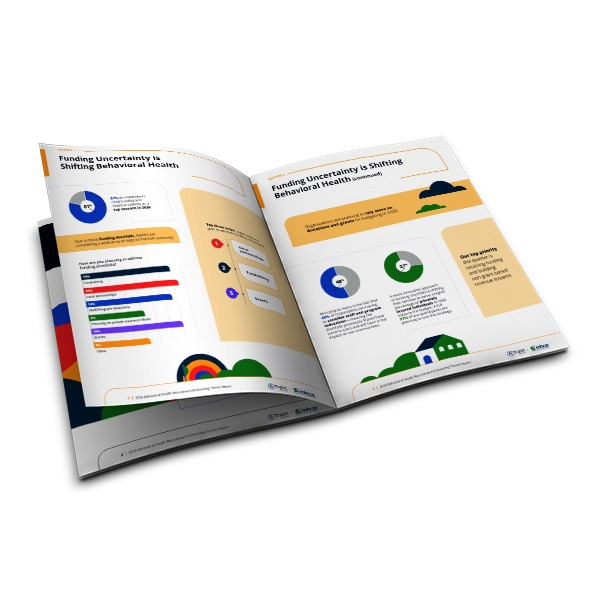
Behavioral health is presently navigating its most significant structural shift in a decade. For years, the industry’s narrative was dominated by a single, persistent challenge: the workforce shortage. But today, the data indicates that the primary source of insomnia for executives has fundamentally changed. According to the 2026 Behavioral Health Recruitment & Branding Trends Report—a joint, nationwide research initiative between A-Train Marketing and mhca—a new crisis has taken the top spot.
While creating and maintaining strong teams is still a major hurdle, organizations are now viewing the lack of funding stability as their primary concern. In an industry facing tightening budgets, shifting policy pressures, and a digital compliance “landmine,” organizations must elevate their presence and move beyond the status quo of traditional operations to maintain their financial footing.
The 81% Alarm: A New Financial Reality
Financial stability is clearly top of mind for behavioral health leaders. For the first time in recent history, this concern is the number one operational hurdle their organizations face. Our research, which gathered primary insights from CEOs, marketing directors, and talent acquisition leaders across the U.S., shows that a staggering 81% of surveyed executives now cite funding and revenue consistency as their primary concern in 2026.
%
A shift like this does not occur in a vacuum, of course. It is powered by a blend of economic and policy pressures—issues that have made funding feel increasingly precarious. For many organizations, the “wait and see” approach is no longer an option.
%
The facts and figures reveal that monetary shortfalls, which leaders have feared, are now arriving at their doorsteps. In response, 48% of leaders are actively considering staff and program reductions just to sustain operational continuity. When nearly half of the industry is looking at service cuts, it isn’t just a budget problem. What is unfolding could reasonably be deemed a community health crisis.
%
To counter this, we are seeing a calculated pivot toward revenue diversification. Approximately 27% of organizations are planning to increase their percentage of private insurance clients to balance the books. Others are leaning into local partnerships (16%) or pursuing aggressive grant strategies (15%). This shift toward private pay signifies a fundamental change in how Community Behavioral Health Centers (CBHCs) view their market role—moving from a pure “safety net” model to a more competitive, balanced insurance mix.
The Donor Paradox and Leaving Capital on the Table
One of the most perplexing findings in our 2026 data is what could be called the “donor paradox.” The report shows that organizations are becoming more dependent on grants and donations to survive. Even so, investment in donor cultivation is moving in the wrong direction. The number of organizations saying they will not be investing in donor campaigns has grown to 44% in 2026 compared to 31% in 2025.
In a period of funding volatility, donor cultivation isn’t an “extra” expense. Rather, it is a diversification strategy. Reducing your outreach to donors at the exact moment your dependence on them increases is a recipe for long-term instability.
Forward-thinking leaders must allocate targeted funding toward professional cultivation to bridge the gap and engage with donors as a source of stable, non-grant-based revenue. Cultivating individual and corporate donors provides a flexible revenue stream that grants—frequently tied to very specific outcomes—cannot provide.
Branding as the Foundation of Recruiting

If funding is the primary concern, recruitment is a close second, with 52% of organizations still identifying staffing as a top challenge. But in 2026, the nature of this challenge has evolved. It is not simply about filling open positions. Instead, a full-scale salary and branding war is underway.
The competition for licensed clinicians (LCSWs, LPCs, LMFTs), substance use counselors, and nursing staff has reached a fever pitch. A massive 88% of leaders describe the current recruitment environment as moderately to very competitive. The problem is that many CBHCs are still relying on passive recruitment: posting a job description on a board and waiting for inquiries to come.
Our data shows that this heavy reliance on job boards and referrals is no longer sufficient. To win in 2026, organizations must shift from “hiring” to employer branding. Your prospective employees aren’t just looking for a job. Instead, they are looking for a culture that corresponds to their values. If your digital presence doesn’t communicate your unique workplace culture—and do it clearly—you will lose the talent battle to for-profit competitors who are spending more on their brand exposure. You must activate a culture-forward employer brand across all digital channels to stay competitive.
Solving the Millennial Recruitment Riddle

The hardest demographic to reach remains Millennials (ages 29–44). Our survey found that this challenge is intensifying, with CBHCs struggling to interact successfully with this audience. Millennials are currently the “backbone” of the clinical workforce, and unfortunately, many organizations are failing to attract them due to issues like higher salaries paid elsewhere and culture/fit misalignment.
How can organizations solve this riddle? That is the essential question. They are finding that they must modernize their recruitment messaging and practices.
Millennials appreciate transparency, work-life balance, and a clear sense of social impact. If your application process is clunky or your website feels like it hasn’t been updated since 2010, you are signaling to this tech-savvy generation that your organization is behind the curve. Modernizing the application process and tailoring your messaging directly to their professional values—especially focusing on workforce sustainability and engagement—is no longer a luxury. In today’s competitive talent market, it is a requirement for survival.
The 78% Fiction: A Digital Compliance Landmine
Perhaps the most urgent and alarming discovery in the 2026 report is that there are significant ADA and HIPAA compliance gaps. A dangerous disconnect exists between how leaders perceive their digital fitness and the reality of their public-facing websites.
%
❌ The Perception
78% of respondents were “very confident” that their websites were fully HIPAA and ADA compliant.
%
✅ The Reality
A-Train’s manual audit of these same organizations found that only 21% were actually compliant.
This means the vast majority (79%) of organizations are non-compliant, leaving them open to regulatory risk. In 2026, this is more than a technical oversight. It is a direct threat to your bottom line. Government entities seem to be actively searching for reasons to pull funding, and a new ruling is intensifying these audits. Non-compliance with ADA and HIPAA standards directly jeopardizes Medicaid revenue streams.
Lack of compliance creates an enormous organizational risk. Leaders cannot afford to operate under false confidence. Ignoring issues with your public website is essentially inviting an audit that could result in devastating financial penalties. Immediate remediation of your digital properties should be the top operational priority for the next 12 months.
Eliminating Your Marketing Blind Spot
At a time when every dollar counts, you would assume that every marketing and recruitment dollar is being tracked. Unfortunately, the 2026 data shows a significant ROI blind spot. More than third (36%) of respondents admitted they are not formally measuring their marketing and communications ROI.
Common refrains from our survey included “We are not formally measuring,” “Not consistently,” and simply “Not well.” When you don’t track your analytics, you are effectively giving away market share to for-profit entities that are using data to target your local patients and talent pool. These competitors are often better at understanding audience needs and engagement preferences. Without foundational web analytics—such as Google Analytics—you might be wasting marketing spend on campaigns that don’t convert. Deploying these tools remains essential to defend your organization’s mission and impact.
AI Generates Excitement and Uncertainty

As we look toward the remainder of 2026 and beyond, artificial intelligence (AI) has become a major point of interest. Behavioral health professionals are eager to learn how AI can assist in both recruitment and marketing. However, there is a large confidence gap here as well: Few organizations feel completely prepared for the client behavior shifts that AI will trigger.
Most organizations are in the early stages of adopting AI technologies into their processes and are looking for more resources on these tools. We recommend investing in exploratory AI training now so your team can develop an understanding of how to use them appropriately and successfully.
Sustained Support: The Power of Partnerships

To address the long-term hiring gap, leaders are moving their talent pipelines upstream. Instead of competing for the same small pool of active jobseekers on public boards, forward-thinking organizations are establishing structured partnerships with regional universities.
By partnering with universities earlier, you can build brand awareness and loyalty before clinicians ever enter the job market. These partnerships fulfill a dual purpose: They provide a steady stream of new clinical talent and increase your organization’s overall community participation and visibility. This is a key strategy for workforce stability and long-term retention.
A-Train Marketing: A Different Kind of Agency
At A-Train Marketing, we recognize that these operational headwinds are indisputable, but they can be overcome. Unlike many healthcare marketing agencies that offer one-size-fits-all solutions, we work as an extension of your team—immersing ourselves in your mission and the details of your care delivery. Our approach is informed by both data and empathy, overcoming the complexities of regulatory obstacles and the subtle psychology behind patient and provider behavior.
We specialize in healthcare marketing because we believe mission-driven organizations deserve the same expertise and strategic firepower as the largest for-profit systems. For nearly 30 years, we have been helping behavioral health organizations, public health entities, and recovery centers navigate their industries with purpose and scale with confidence. Our work is grounded in accessibility, inclusivity, and ethics—making sure your messaging is not merely compliant but compelling.
Why Measurable Growth Matters
Our team doesn’t chase clicks. We focus on helping you attract the right talent and build a brand that people trust. At A-Train, healthcare digital marketing is more than tactics—for many of our clients, it involves a complete transformation. Every touchpoint we design is grounded in strategy and built to perform.
Our expertise includes everything from healthcare SEO and paid media to custom analytics dashboards that bring your ROI into full view. We make sure that every campaign is tracked, optimized, and tied to outcomes that matter—whether that’s patient volume, brand trust, or any other objective.

2026 and Beyond: A Roadmap for Behavioral Health Leaders
Based on the findings of the 2026 Behavioral Health Recruitment & Branding Trends Report, we recommend four key pillars of action for the next 12 months:
- Compliance confirmation/remediation. Conduct an expert audit of your HIPAA and ADA compliance to protect your Medicaid funding from tightening government requirements.
- Culture-forward branding. Stop treating recruitment like a transaction. Invest in your employer brand and mission-focused recruitment messaging to attract the talent that will sustain your workforce.
- Supporter cultivation. Don’t fall into the donor paradox. Diversify your revenue by putting resources into professional fundraising and targeted donor outreach.
- Data-driven initiatives. Implement custom analytics dashboards to track your outreach ROI. Don’t be outmaneuvered by for-profit competitors who are using data to win.
Data as the Driver for a Stronger Future
The findings in the report highlight deep structural shifts, but they also reveal an explicit roadmap for forward-thinking leaders. By confronting funding volatility and recruitment roadblocks with proactive, evidence-based strategies, community behavioral health centers can secure their market positions.
Implementing data-informed strategies will directly improve your recruitment success and ensure long-term stability. Together, we can transform these operational pressures into powerful opportunities for institutional growth and deeper community service.
Claim Your Free Compliance and Competition Insights
To help you steer through these turbulent times, A-Train is proud to offer mhca members a complimentary digital compliance check and a customized local competition analysis. Our team of experts will review your website for hidden HIPAA or ADA vulnerabilities and evaluate how aggressive for-profit entities are targeting your local talent pool.
Secure your vital public funding and strengthen your market visibility today. Let A-Train help you turn the data of 2026 into a competitive advantage for your organization. Claim your free compliance and competition insights now and make the first step toward a stronger, more resilient future.
Download
the Full
2026 Behavioral Health Recruitment and Branding Trends Report
Please provide you name and email below to receive a download link to the full report.